
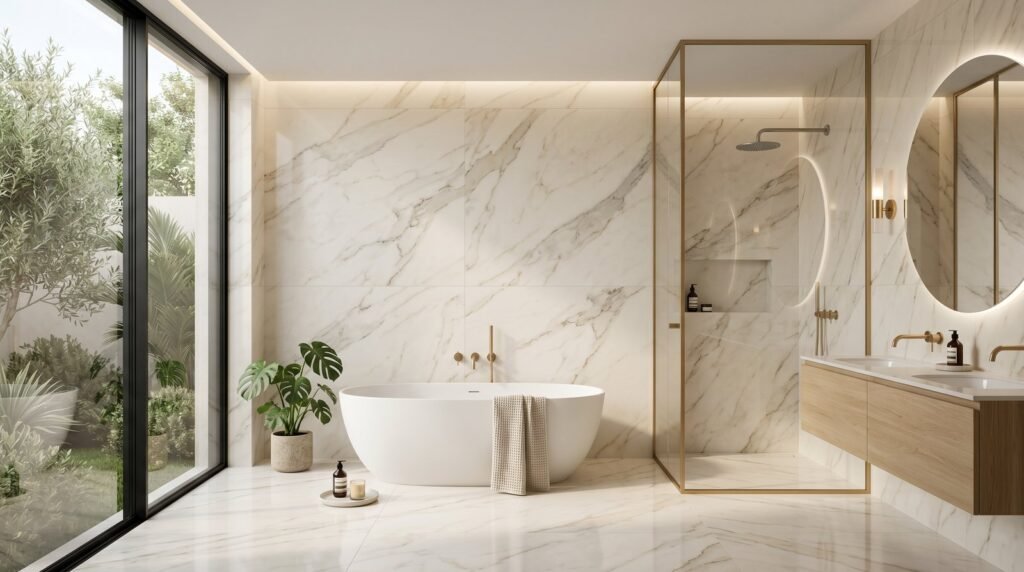
Ask most homeowners and they will tell you the same thing: they spent weeks choosing their sanitaryware and very little time thinking about the tiles that surround it. This is a costly mistake. Wall tiles cover the largest continuous visual surface in any bathroom, and the wrong choice — wrong scale, wrong finish, wrong tone — will undermine even the most expensive Duravit basin or Hansgrohe shower system.
Across premium residential projects in Gurugram, Delhi NCR, and Bengaluru, the architects and interior designers who specify the most considered bathrooms all follow a set of principles that rarely appear on product-catalogue pages. This guide draws on those real-world insights to help you choose the best tiles for bathroom walls in India 2026 — whether you are building new, renovating, or specifying for a client.
Why Wall Tiles Matter More Than You Think
In a typical Indian bathroom measuring 50 to 80 square feet, the wall surface area is three to four times greater than the floor area. Walls are what your eye rests on. They establish the mood of the space before you register any fixture or fitting.
A common error is treating wall tiles as a neutral backdrop to support the sanitaryware. In premium bathroom design, the relationship works the other way: the wall tile sets the architectural character of the room, and the sanitaryware is selected to complement it. Architects who work on high-specification projects consistently report that clients who shortchange the wall tile budget regret it far more than those who invest in quality from the start.
Wall tiles also bear functional weight in Indian bathrooms. The wet Indian bathroom — used with a bucket, hand-held shower, or overhead shower with no separate wet zone — means walls need to handle direct water contact, humidity, and regular cleaning. The tile you choose must perform as well as it looks.
Tile Types for Bathroom Walls in India: A Practical Comparison
Understanding the material is the first decision. For a more detailed breakdown of how ceramic and vitrified tiles differ in manufacturing, durability, and application, see the guide on ceramic vs vitrified tile types.
Ceramic tiles remain the most common choice for Indian bathroom walls, particularly in mid-range projects. They are lighter than porcelain, easier to cut, and available in a wide range of surface prints and textures. For walls — where load-bearing is not a concern — the lower density of ceramic is actually an advantage. The limitation is absorption rate: ceramic tiles are more porous, so grout and tile edges in wet zones need proper waterproofing.
Porcelain tiles are the architect’s preferred specification for premium walls. Fired at higher temperatures, they are denser, less porous, and far more consistent in tone and dimension. Large-format porcelain — particularly marble-look panels — produces the seamless, vein-matched surfaces seen in luxury hotels and high-end residential projects.
Vitrified tiles, once confined to floors, now appear extensively on walls in large format sizes. Their low water absorption makes them ideal for Indian wet bathrooms. The technical limitation is weight: very large vitrified slabs require proper substrate preparation and skilled installation.
Glass mosaic tiles work best as accent elements — inside a shower niche, along a feature band at eye level, or as a full accent wall in a powder room. They add reflectivity and depth, and pair well with both matte and satin field tiles.
Zellige and handmade tiles are among the most specced accent tiles in premium 2026 projects. Their characteristic variation in glaze and surface — each tile subtly different from the next — creates a warmth that machine-made tiles cannot replicate. They are expensive and require experienced tilesetters, but the result is distinctive.
Large-format porcelain slabs (900x1800mm and above) represent the upper end of wall tile specification. Sourced from Italy and Spain, these panels can be booked-matched to create mirror-image stone veining across an entire wall — a technique borrowed from luxury hospitality design.
Size Guide: What Works on Indian Bathroom Walls
Scale affects spatial perception in ways that are often underestimated. Here is how the most common formats perform on Indian bathroom walls:
- 300x600mm — The workhorse of Indian bathroom wall tiling. Laid vertically, it draws the eye upward and makes a room feel taller. Extremely practical, widely available, and easy to install. Works at every price point.
- 300x900mm — A format gaining popularity with architects. The longer format gives walls a more refined, contemporary rhythm, particularly in a stacked horizontal layout.
- 600x1200mm — The go-to large format for premium bathrooms. Fewer grout lines mean a cleaner, more expansive look. Works exceptionally well with marble-look porcelain where continuity of pattern matters.
- Metro/subway tiles (75x300mm or 100x200mm) — Returned with considerable force in 2025 and remain strong in 2026, particularly in ribbed or bevelled form. Excellent for creating a curated, editorial bathroom aesthetic without the cost of full large-format specification.
- Mosaic (typically 25x25mm to 50x50mm on mesh) — Best used as accents. A full bathroom tiled in mosaic requires intensive grouting and maintenance; reserved for shower floors, niches, and feature panels.
For small Indian bathrooms, the conventional wisdom to use small tiles in small spaces is now largely rejected by leading designers. A large-format tile with fewer grout lines often makes a compact bathroom feel more spacious than a busy small-format pattern.
Finish Guide for Bathroom Walls: Glossy, Satin, Matte, Textured
The finish question is one of the most common points of confusion — and the answer for walls is quite different from floors. A detailed editorial on matte vs glossy tile finishes covers the full spectrum, but here are the wall-specific principles.
Glossy tiles are well-suited to bathroom walls in ways they are not to bathroom floors. On a wall, there is no slip hazard. The reflectivity of a gloss finish bounces light around a compact room, making it feel brighter and larger. In north-facing bathrooms — common in Indian residential layouts — glossy tiles compensate for limited natural light. The maintenance concern is water spots and soap residue, which show more readily on high-gloss surfaces; this can be managed with squeegee habits and quality grout.
Satin and semi-gloss finishes represent the most specified option across premium Indian projects in 2026. They offer gentle light reflection without the stark mirror effect of full gloss. Marble-look porcelain in satin finish reads as convincingly stone-like, which is partly why this combination has become the dominant choice for luxury bathroom walls.
Matte tiles on walls create a calm, spa-like atmosphere. They read beautifully in photographs and show remarkable depth with textured surfaces. The limitation in Indian bathrooms is that matte walls can accumulate soap scum more visibly in heavy-use bathrooms; they are better suited to powder rooms or low-moisture wall sections.
Textured and relief tiles — fluted, ribbed, wave, and 3D relief — are among the strongest trends for bathroom walls in 2026. These tiles add tactile and visual depth without the complexity of pattern, making them easy to layer into otherwise minimal schemes.
Colour and Pattern Trends 2026: What Is Actually Being Specified
The 2026 bathroom design trends emerging from premium Indian projects reflect a broader shift in interior design toward warmth, depth, and materiality over the cool minimalism of the previous decade.
Marble-look porcelain remains the single most specified bathroom wall tile across premium Indian residential projects. The combination of natural aesthetics with the technical performance of porcelain makes it the rational luxury choice.
Warm neutrals anchored by Pantone’s 2026 Colour of the Year, Mocha Mousse, are translating directly into tile specifications. Warm beige, greige, and caramel tones — particularly in textured or fluted formats — are replacing the cooler greys that dominated 2022-2024. These tones pair naturally with warm brass fixtures and timber vanity elements.
Sage and olive greens have transitioned from accent to primary wall colour in many 2026 projects. Deep sage in a large-format satin porcelain creates a bathroom that feels both contemporary and deeply calming.
Fluted and ribbed textures continue to be heavily specified, particularly as accent panels behind vanities or inside wet areas. A single fluted wall in a bathroom — even in a neutral colour — creates enough visual interest to render additional pattern unnecessary.
Dark, dramatic walls are appearing in more premium Indian bathrooms. Deep charcoal, slate blue, and near-black are used particularly in master en-suite bathrooms, where the enclosed quality of the room allows drama that would feel oppressive in a living space.
Terrazzo-look tiles — whether genuine terrazzo or porcelain prints — bring warmth and personality to bathrooms without the upkeep demands of real stone.
For help matching colours across a complete bathroom palette, the editorial on tile colour combinations is a useful companion resource.
Full-Height Tiling vs Half-Height: The Indian Debate
Indian bathrooms have historically been tiled floor to ceiling — a practical response to the wet bathroom tradition where water reaches all wall surfaces. The question architects face increasingly is whether this approach still applies to modern Indian bathrooms designed with enclosed shower zones and water-managed layouts.
The case for full-height tiling remains strong in most Indian contexts. Even in bathrooms with enclosed showers, steam, condensation, and general humidity mean that paint or partially tiled walls age poorly. Full-height tiling also lends a sense of cohesion and grandeur — particularly when large-format tiles run seamlessly from floor to ceiling with minimal grout lines.
Half-height tiling — typically tiling to 1200mm or 1500mm with a painted or plastered zone above — works well in powder rooms and guest bathrooms where wet usage is minimal. It also creates an opportunity for an architectural expression: the tile-to-paint line becomes a design feature, particularly when the painted zone is in a complementary deep tone.
The compromise many architects now specify is full-height tiling in the wet zone with a change in tile format or finish above the functional height, creating visual zoning without sacrificing protection.
What Architects Actually Specify for Premium Indian Bathrooms
Drawing on specifications across luxury residential projects in Gurugram and Delhi NCR, several consistent patterns emerge in what architect-recommended tile selections look like in practice:
Large-format marble-look porcelain as the primary wall tile. Typically 600x1200mm or 800x1600mm, in a satin finish, vein-matched across adjacent tiles. The material communicates luxury clearly while requiring less maintenance than real stone.
A contrasting accent wall in texture. A fluted tile, a relief surface, or a zellige accent wall — usually on the wall directly opposite the entry point, creating visual arrival into the space.
Niche shelving with a contrasting tile insert. Recessed niches in the shower area tiled with a mosaic or a complementary tile in a different tone or format. This detail is small in area but significant in perceived craftsmanship.
Consistent specification of Hansgrohe or Duravit fixtures to complement the tile quality. Architects note that the quality of the tile and the quality of the fixture are always read together — a poorly specified shower fitting undermines an excellent tile, and vice versa.
De Ceramica curates a range of wall tile collections specifically selected to support this specification approach — from large-format Italian porcelain to handcrafted accent tiles — available to view at its Gurugram showroom. Browse the full tile collection or explore complementary sanitaryware and basins to complete the bathroom specification.
How De Ceramica Curates Bathroom Wall Tiles
De Ceramica’s approach to wall tile curation is guided by the same principles architects bring to premium project specification: performance, scale, and how a tile reads across an entire wall rather than in a small sample. The focus is not on the widest possible range, but on tiles that genuinely perform — aesthetically and technically — in Indian bathroom conditions.
The showroom in Gurugram allows clients and design professionals to view tiles at full scale alongside complementary collections and sanitaryware. Whether specifying a master bathroom for a high-end residential project or planning a thoughtful renovation, the team brings the same rigour to wall tile selection that the best architects apply to bathroom wall tiles design in India.
Frequently Asked Questions
What type of tile is best for bathroom walls in India?
Porcelain tiles are the best choice for bathroom walls in most Indian homes. They are dense, low-absorption, and available in formats that suit both compact and large bathrooms. Ceramic tiles are a practical mid-range option for dry-area walls. For premium bathrooms, large-format porcelain in marble-look or textured finishes is the most specified category in 2026.
Should bathroom walls be fully tiled in India?
In most Indian bathrooms, full-height tiling is the recommended approach. The wet bathroom tradition — including bucket usage, hand showers, and steam — means that exposed plaster or paint above a tile line is prone to moisture damage over time. Full-height tiling also creates a more polished, cohesive look. For powder rooms with minimal wet usage, half-height tiling with a quality paint above is a reasonable alternative.
What tile size is best for small Indian bathroom walls?
Counter-intuitively, larger format tiles often work better in small Indian bathrooms than small-format tiles. A 300x600mm or 600x1200mm tile with fewer grout lines makes a compact space feel more expansive. Small mosaic tiles on large wall areas tend to make a room feel busier and smaller. The key is to choose a tile whose scale is proportionate to the room rather than automatically defaulting to the smallest available format.
Are large-format tiles good for bathroom walls?
Yes, large-format tiles are excellent for bathroom walls when the substrate is properly prepared and the installation is done by experienced tile setters. On walls, weight is distributed differently from floors, but large porcelain slabs still require appropriate adhesive, back-buttering, and support. The result — especially with marble-look or stone-effect tiles — is a seamless, high-quality finish that is consistently preferred in premium Indian bathroom projects.
What are the trending bathroom wall tile colours for 2026?
The dominant colour directions for Indian bathroom walls in 2026 are: warm neutrals in the Mocha Mousse family (warm beige, caramel, greige), sage and olive greens, deep charcoal and near-black for dramatic en-suites, and the continued dominance of marble-look whites and warm veined tones. Cool greys, which dominated the previous three to four years, are being phased out in favour of warmer, more enveloping palettes.
How much do premium bathroom wall tiles cost in India?
Premium bathroom wall tiles in India range from approximately Rs 80 to Rs 250 per square foot for high-quality domestic porcelain, to Rs 300-800 per square foot for imported Italian or Spanish large-format porcelain slabs. Handmade tiles such as zellige can reach Rs 1,000 per square foot or above. Installation costs for large-format tiles are higher than standard sizes due to the skill and material requirements involved. For accurate pricing based on your specific bathroom dimensions and tile selection, a consultation at the De Ceramica showroom will give you a precise estimate.
Visit De Ceramica in Gurugram
For bathroom wall tile selection across every budget and style — from marble-look Italian porcelain to handcrafted accent tiles — visit the De Ceramica showroom at:
A-511, Sushant Lok Phase 1, Gurugram
Phone: +91 85880 09989
The showroom team includes design consultants experienced in working alongside architects and interior designers on premium residential projects across the Delhi NCR. Samples, specification support, and sourcing assistance are available for both individual homeowners and trade professionals.