
Best Tiles for Indian Kitchens: Anti-Skid, Heat-Resistant & Easy-to-Clean Options (2026 Guide)
Choosing the right tiles for your Indian kitchen
An Indian kitchen works harder than almost any other room in the house. Hot oil splashes near the stove, turmeric and masala stains that set in within minutes, water pooling during vessel-washing, and constant footfall through the day — the tile underfoot has to survive all of it without losing its finish or becoming a safety hazard. Choosing the right tile isn’t a cosmetic decision; it’s a durability decision that affects how the kitchen looks and functions for the next fifteen to twenty years.
This guide breaks down what actually matters when selecting kitchen tiles in India — slip resistance, heat performance and everyday cleanability — and compares the tile types that hold up best, so you can shortlist with confidence before you visit a showroom.
What makes a tile 'right' for an Indian kitchen?
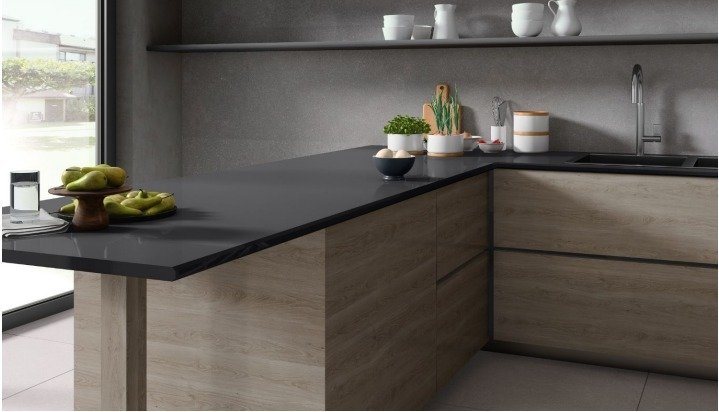
A kitchen tile isn’t judged the way a living room or bedroom tile is. Looks still matter, but three functional properties decide whether a tile performs well for years or starts showing problems within months: how safe it is when wet, how it handles direct and radiant heat near the cooktop, and how easily it resists and releases stains from oil, turmeric and spices. Get these three right, and the aesthetic choices — colour, finish, format — become far more flexible.
It is worth being clear about what doesn’t matter as much as people assume. A tile doesn’t need to be the most expensive option in the showroom to perform well in a kitchen — it needs the right density, the right finish, and the right format for how an Indian kitchen is actually used day to day.
Anti-skid tiles: the non-negotiable starting point
Indian cooking involves constant water use — washing vegetables, rinsing utensils, mopping up spills mid-cook. A glossy, high-shine tile looks premium in a showroom but becomes genuinely dangerous the moment it’s wet. Anti-skid tiles, sometimes labelled matte-finish or textured, have a surface profile that increases friction underfoot without sacrificing the finished look.
- Check the slip resistance rating (R9 or above) whenever comparing options at a showroom.
- Matte and satin-finish porcelain or vitrified tiles deliver anti-skid performance without looking flat or dull.
- Keep full-gloss polished tiles out of the sink, stove and washing zones, even if used elsewhere in an open kitchen layout.
Anti-skid tiles: the non-negotiable starting point
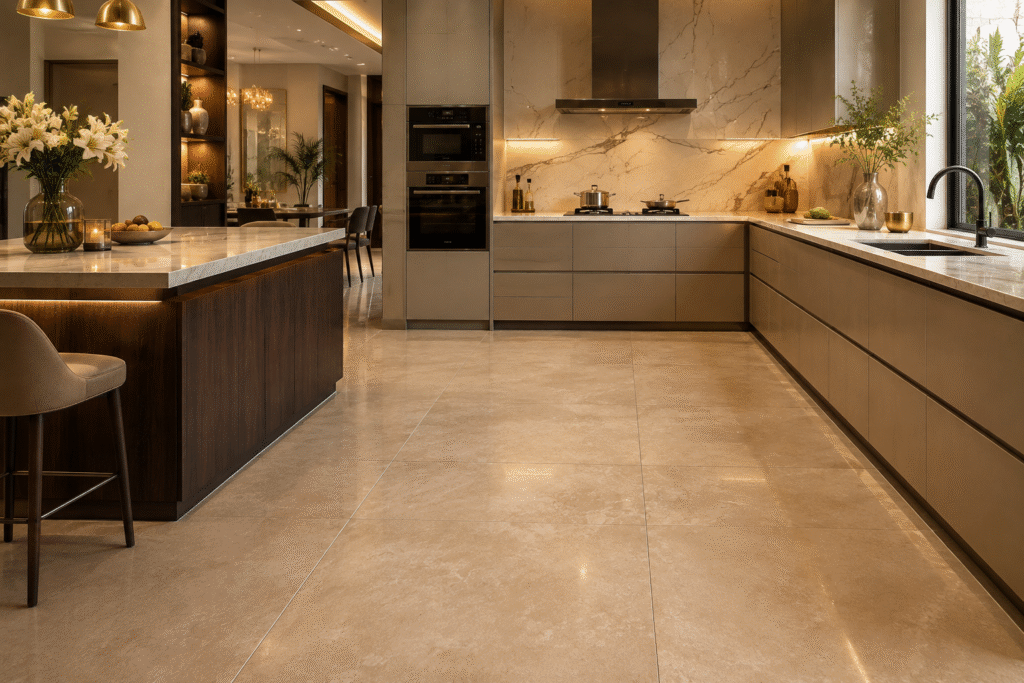
Porcelain vs vitrified vs ceramic: side-by-side comparison
| Tile Type | Slip Resistance | Heat Tolerance | Best For | Indicative Cost (India 2026) |
|---|---|---|---|---|
| Porcelain (matte/satin) | Excellent | Excellent — lowest water absorption | Stove zone, backsplash, high-use floors | ₹120 – ₹450+ per sq ft |
| Vitrified (matte) | Very Good | Very Good — dense, non-porous | Full kitchen flooring, budget-conscious luxury | ₹80 – ₹300 per sq ft |
| Marble-look porcelain | Good (matte finish) | Excellent | Design-forward kitchens wanting a stone look | ₹150 – ₹500+ per sq ft |
| Ceramic (glazed) | Fair — avoid near sink/stove | Fair — more porous | Low-moisture accent areas only | ₹40 – ₹150 per sq ft |
Prices are indicative for 2026 and vary by brand, finish and import origin. For an exact quote on the tiles suited to your kitchen, it’s best to see samples in person.
Heat-resistant options: protecting the zone near the stove protecting the zone near the stove
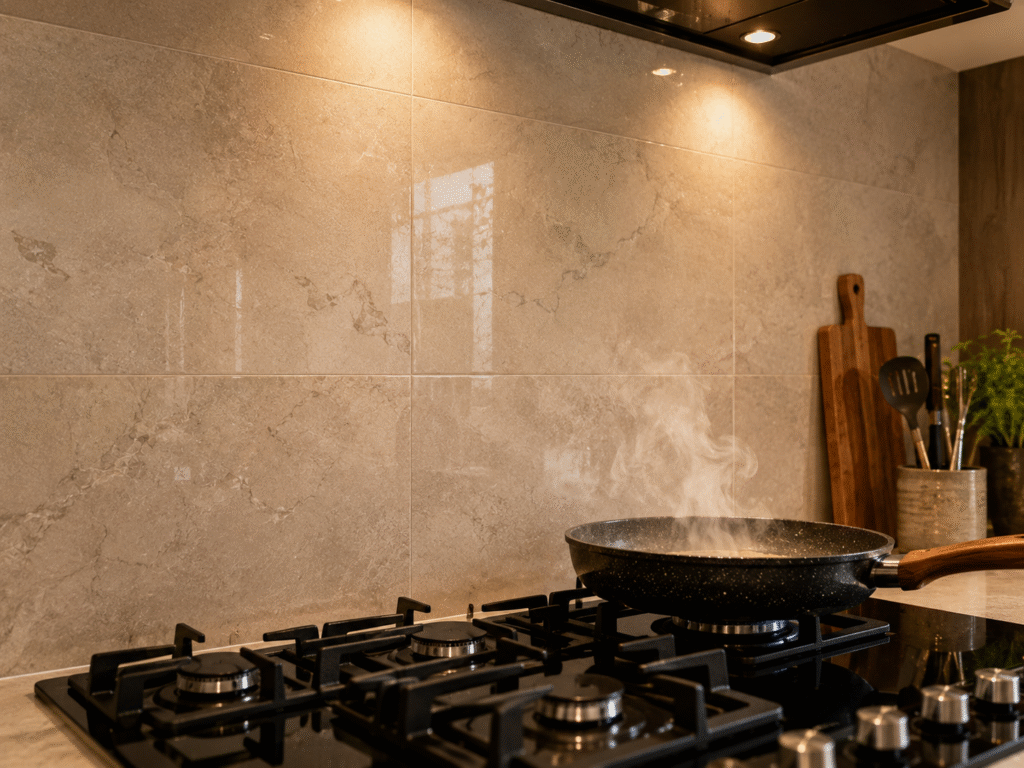
The area around the cooktop deals with radiant heat, occasional spills from hot vessels, and steam from daily cooking. Porcelain and vitrified tiles are fired at very high temperatures during manufacturing, which is exactly why they resist warping, cracking and discolouration when exposed to heat over time — a natural result of how densely the material is fused.
- Porcelain: the lowest water absorption of all tile types and the strongest heat tolerance — the standard choice for backsplashes and stove-adjacent flooring.
- Vitrified: dense and non-porous, holding up well against the thermal stress of daily cooking without cracking.
- Natural stone: needs proper sealing near heat sources — untreated porous stone can develop micro-cracks from repeated heat cycles.
Easy-to-clean surfaces: the everyday practical factor
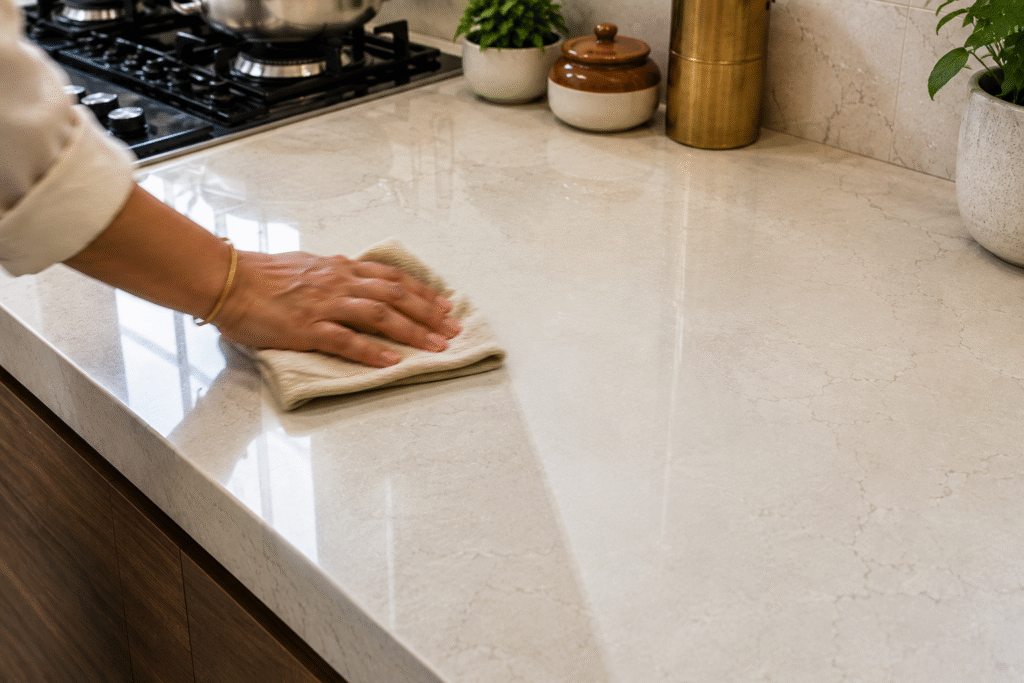
Turmeric, oil and masala stains are a daily reality in Indian kitchens, and the tile surface determines whether cleanup takes thirty seconds or thirty minutes. Low porosity is the deciding factor — it keeps stains sitting on the surface rather than soaking into the tile body.
- Porcelain and vitrified tiles absorb far less liquid than ceramic, making daily wipe-downs genuinely effortless.
- Marble-look porcelain delivers the aesthetic of natural stone with none of the sealing and staining maintenance real marble demands.
- Large-format tiles reduce the number of grout lines — and grout is where most kitchen grime and staining actually accumulates over time.
Easy-to-clean surfaces: the everyday practical factor
Design doesn't have to take a back seat
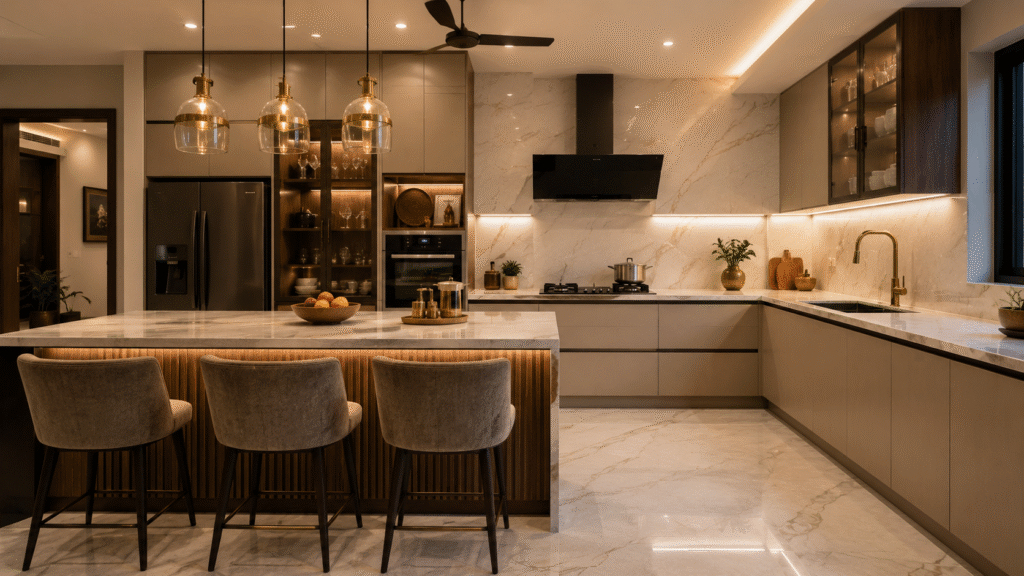
Functional doesn’t mean plain. Marble-look porcelain tiles have become a popular choice for Indian kitchens precisely because they deliver the veined, luxury look of Italian marble while offering the stain resistance and low maintenance that natural stone can’t match. Large-format tiles also give kitchens a more seamless, expansive feel — a genuine advantage in the compact kitchen layouts common across Gurgaon and Delhi NCR apartments, where visual continuity matters more than in larger homes.
So where should you begin?
Start with the base material — porcelain or vitrified — before choosing colour or pattern. Once the material is settled, narrow down finish (matte for safety near wet zones) and format (large-format for a seamless, low-maintenance look). Backsplash and flooring can use the same family of tile in different finishes for a cohesive result, rather than mixing unrelated collections.
If budget means choosing between an imported Italian marble-look porcelain and a locally manufactured vitrified equivalent, consider how the kitchen is actually used — a high-traffic joint family kitchen benefits most from vitrified’s affordability and resilience, while a showcase kitchen used primarily for entertaining can justify the premium finish of imported porcelain.
See it all at De Ceramica, Gurgaon
Photos and specification sheets only tell you so much — finish, texture and how a tile actually behaves underfoot are best judged in person. At De Ceramica’s showroom, our tiles and surfaces range spans imported Italian and Spanish collections, marble-look porcelain, and large-format designer tiles suited specifically to Indian kitchen conditions.
With more than 21 years in the industry, our team offers personalised guidance on slip ratings, heat performance and maintenance needs for each option, helping you shortlist tiles that fit your kitchen’s layout, budget and household’s daily use — not just what looks good in a catalogue.
Visit us at A-511, Sushant Lok Phase 1, opposite IFFCO Chowk Metro Station, Gurugram, or book a free design consultation and we’ll help you plan a kitchen that performs as well as it looks
Frequently asked questions
Q.1 Which tile is best for Indian kitchen flooring — porcelain or vitrified?
Both perform well. Porcelain offers marginally better heat tolerance and the lowest water absorption, making it the premium choice. Vitrified delivers similar durability at a more accessible price point and is widely used across Gurgaon and Delhi NCR kitchens. For most homes, either is a safe choice as long as the finish is matte or satin.
Q.2 Are anti-skid tiles less shiny or attractive than glossy tiles?
Not anymore. Modern matte and satin-finish porcelain and vitrified tiles offer rich colour depth and marble-look finishes without the high-gloss shine — meaning you get slip resistance without compromising on aesthetics.
Q.3 How do I reduce grout staining in a kitchen with tiles?
Choose large-format tiles to minimise the number of grout lines, opt for a darker or epoxy grout that resists staining, and wipe up oil and turmeric spills as soon as they happen rather than letting them sit on the grout line.