
Italian Tiles vs Vitrified Tiles: Which Is Right for Your Home?
Italian Tiles vs Vitrified Tiles: Key Differences, Pros & Cons:
If you are choosing tiles for a new home or a renovation, you have almost certainly run into the same question everyone in India faces at the showroom: should you go with Italian tiles or vitrified tiles? On the surface they can look nearly identical, yet they sit at very different points on price, finish and origin. This guide breaks down the real differences so you can decide with confidence. Before we compare them, it helps to clear up one common source of confusion.
“Italian tiles” and “vitrified tiles” are not strictly opposite categories — and that trips up a lot of buyers. Vitrified describes how a tile is made: clay is fused with silica, quartz and feldspar at very high temperatures until the body turns glass-hard and almost non-porous. Italian describes where a tile comes from and the design tradition behind it.
In practice, most premium Italian tiles sold in India are themselves high-grade porcelain (a form of vitrified tile). So the real-world comparison Indian buyers are making is usually this: imported Italian designer porcelain on one side, and domestically manufactured vitrified tiles (largely from Morbi, Gujarat) on the other. That is the comparison we will use throughout.
What are Italian tiles?
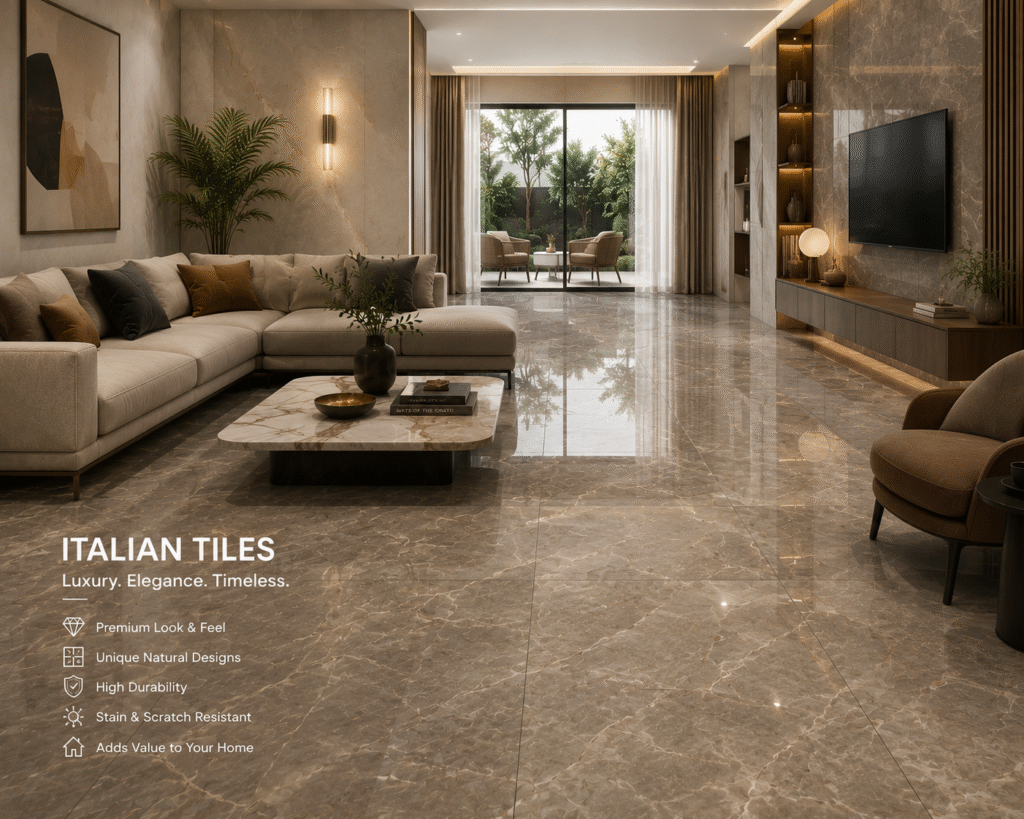
Italian tiles are premium porcelain or ceramic tiles manufactured in Italy, or produced to Italian design standards by heritage brands. Italy has been the global reference point for tile design for decades, and “Ceramics of Italy” is a recognised mark of that pedigree. What you are paying for is design depth, colour accuracy, surface realism and large-format engineering — the reason a marble-look Italian slab can be almost indistinguishable from natural stone.
What are vitrified tiles?
Vitrified tiles are the workhorse of modern Indian interiors. Thanks to the vitrification process, they have very low water absorption (typically under 0.5%), high strength and excellent stain resistance, at a price most homeowners can absorb across a whole house. They come in several grades, including double-charge, glazed vitrified (GVT) and polished glazed vitrified (PGVT), with GVT and PGVT offering the widest range of designs and finishes.
What are vitrified tiles?
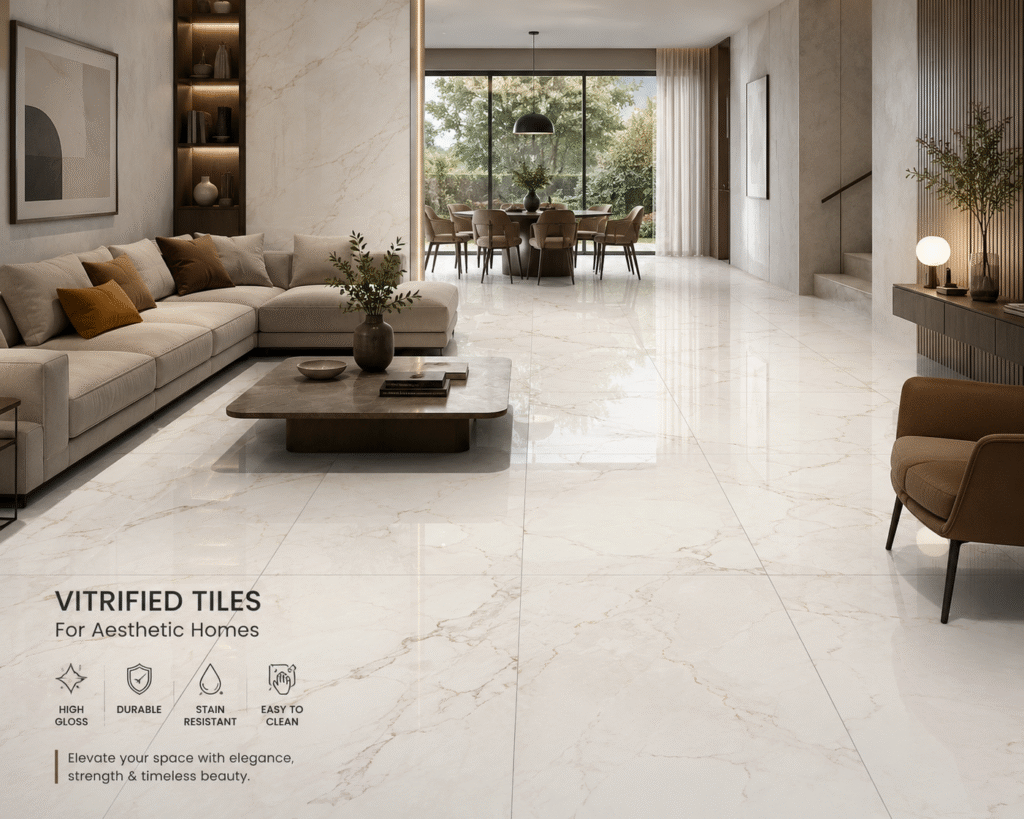
Italian tiles vs vitrified tiles: side-by-side comparison
| Factor | Italian Tiles (imported) | Vitrified Tiles (Indian) |
|---|---|---|
| Origin | Italy / Italian design houses | Primarily India (Morbi, Gujarat) |
| Water absorption | Very low — under 0.5% | Very low — under 0.5% |
| Durability | Excellent | Excellent |
| Design realism | Class-leading — marble & stone looks | Very good in GVT / PGVT grades |
| Large-format / slabs | Widely available up to slab sizes | Available, narrower range |
| Approx. price / sq ft | ₹250 – ₹800+, slabs higher | ₹40 – ₹250 by grade |
| Best suited to | Feature walls, statement floors, luxury bathrooms | Full-home flooring, high-traffic areas |
Prices are indicative for 2026 and vary by collection, size, finish and thickness. For an exact quote, it is always best to see the tiles in person.
Durability: is one actually stronger?
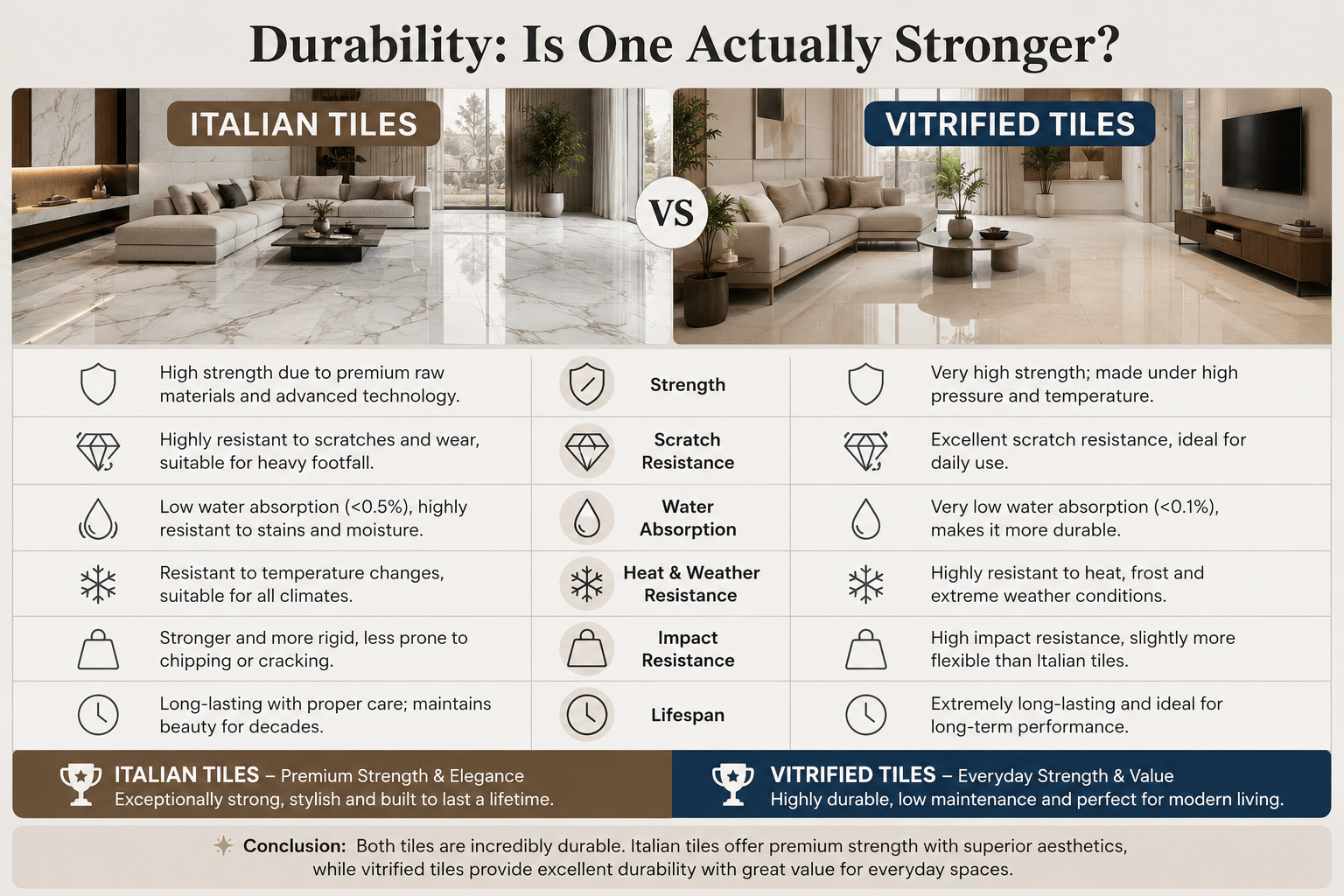
For everyday residential use, both perform extremely well. Quality vitrified tiles are hard, scratch-resistant and easy to maintain, and they are more than adequate for living rooms, kitchens and bedrooms. Italian porcelain is also highly durable, but you are rarely buying it for extra strength — you are buying it for the finish and the design. The honest takeaway: choose on aesthetics and budget, not on a fear that one will wear out faster than the other.
Design and finish: where Italian tiles pull ahead
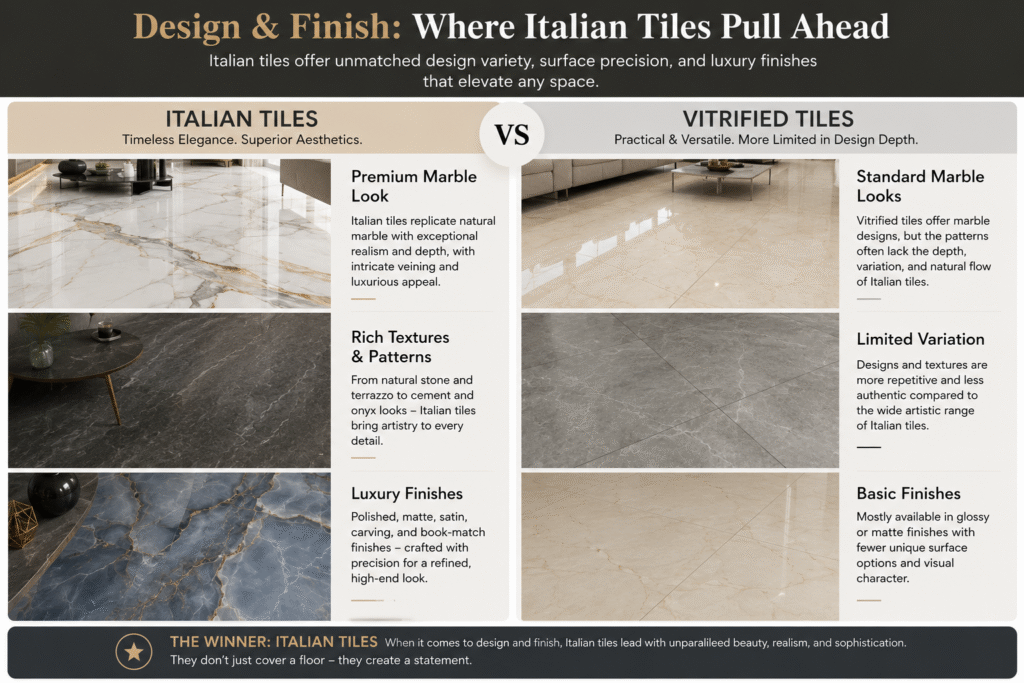
This is the real dividing line. Italian manufacturers invest heavily in surface printing, texture and colour tone, which is why their marble-look and stone-look tiles read as remarkably natural even up close. If you want a book-matched marble feature wall, a large-format slab with minimal grout lines, or a very specific designer aesthetic, Italian tiles give you options that domestic ranges may not match. Premium Indian GVT and PGVT tiles have closed much of this gap and offer outstanding value — but at the very top end, the design edge still belongs to Italy.
Design and finish: where Italian tiles pull ahead
Cost: what you are really paying for
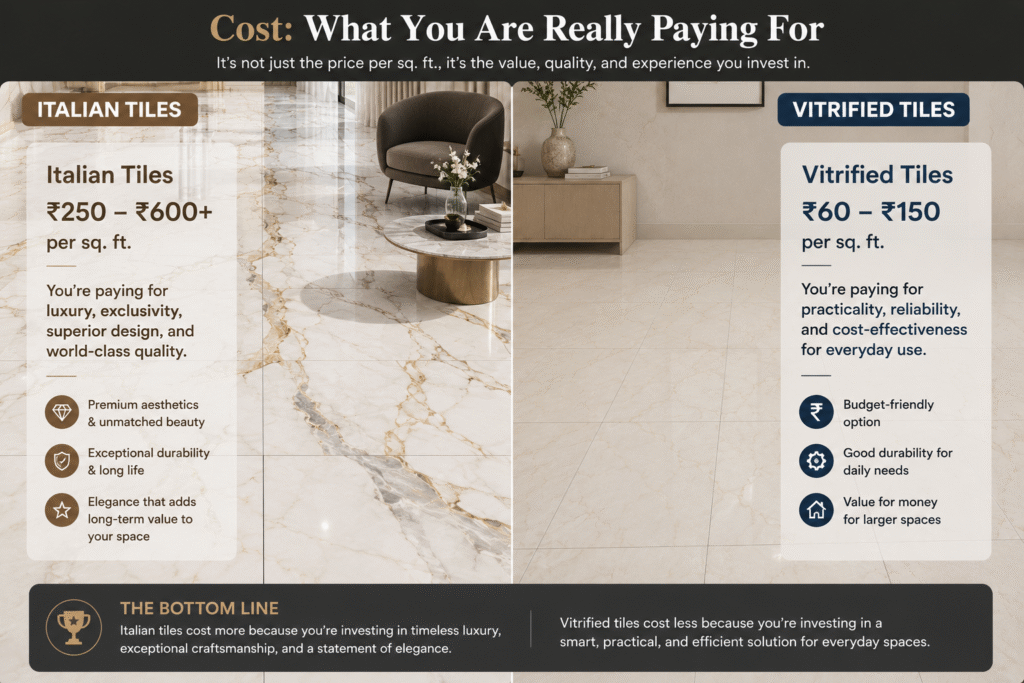
Vitrified tiles win clearly on price and are the sensible choice when you are tiling large areas or working to a budget. Italian tiles carry a design and import premium, so they make the most sense used deliberately — a hotel-style bathroom, an entrance foyer, a living-room feature wall — rather than across every square foot of the house. A very common and cost-smart approach is to mix both: Italian tiles where the eye lands, quality vitrified tiles everywhere else. If you want detailed numbers, our Italian tiles price guide for India 2026 walks through current ranges.
So which should you choose?
Choose vitrified tiles if you want dependable performance across your whole home, a wide selection and the best value for money. Choose Italian tiles when a specific space deserves a standout finish and you want design at its most refined. For most homes, the best answer is not one or the other — it is the right tile in the right place, and that is a decision worth making with samples in hand.
See Italian and vitrified tiles at De Ceramica, Gurgaon
The easiest way to settle this comparison is to stand in front of both. At De Ceramica, our luxury tiles showroom in Gurgaon brings imported Italian collections and premium vitrified ranges together under one roof, so you can compare finish, format and price side by side instead of guessing from a catalogue.
As an authorised partner for names including Ceramics of Italy and Tile of Spain, alongside a curated selection of designer surfaces, we help you match the right tile to the right space — whether that is a marble-look feature wall, a large-format living-room floor, or full-home flooring
built to last. With more than 21 years in the industry, our team offers personalised design guidance and coordinated installation support across Gurgaon and the wider Delhi NCR region.
Visit us at A-511, Sushant Lok Phase 1, opposite IFFCO Chowk Metro Station, Gurugram, or book a free design consultation and we will help you choose tiles you will be happy with for years.
Frequently asked questions
Q.1 Are Italian tiles better than vitrified tiles?
Not automatically. Italian tiles lead on design and premium finishes, while quality vitrified tiles offer excellent durability and far better value. The right choice depends on your budget and where the tile is going.
Q.2 Do Italian tiles need more maintenance?
No. Like vitrified tiles, Italian porcelain has very low water absorption and is easy to clean. Routine care is similar for both.
Q.3 Can I use both in the same home?
Yes, and many homeowners do. Using Italian tiles for feature areas and vitrified tiles elsewhere gives you a high-end look while keeping the overall cost sensible.