
De Ceramica, Gurugram’s leading luxury bath fittings showroom and authorised Hansgrohe Flagship Partner, guides homeowners through one of the most common bathroom upgrade decisions: rain shower vs overhead shower India. With 22+ years of experience fitting bathrooms across Delhi NCR — from DLF Phase 1 and 2 residences to Golf Course Road apartments and Sushant Lok villas — the team at De Ceramica has seen every configuration, every pressure scenario, and every budget. This guide brings together that accumulated expertise so you can make an informed choice before you commit to a product or a plumber.
What Is a Rain Shower vs an Overhead Shower?
Before comparing them, it helps to understand exactly what each fixture is.
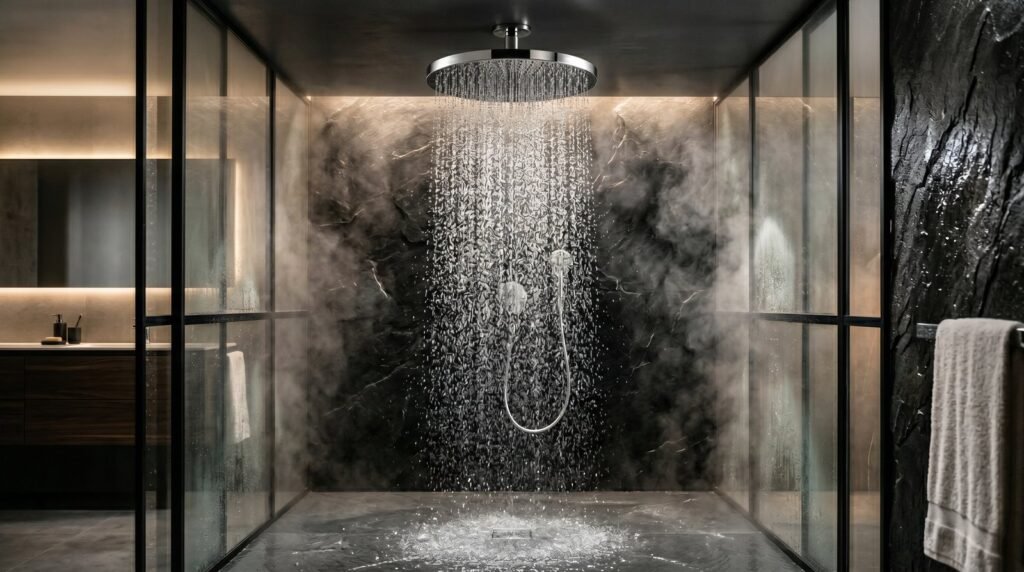
A rain shower (also called a rainfall shower or rain shower head) is a large-diameter overhead fixture — typically 200 mm to 500 mm across — designed to deliver a wide, gentle cascade of water that mimics natural rainfall. The spray nozzles are positioned across a broad face plate and angled downward at roughly 90 degrees, so water falls straight down onto the body. Rain showers are almost always ceiling-mounted or mounted on a tall ceiling arm, and they prioritise full-body coverage and a spa-like sensory experience over high-pressure rinsing.
An overhead shower (sometimes called a top shower or fixed shower head) is a compact, wall-mounted or wall-arm-mounted fixture — typically 100 mm to 200 mm in diameter — that delivers a more concentrated spray. It is the most common shower format in Indian bathrooms and is valued for its ease of installation, compatibility with low water pressure, and lower price point. Overhead showers focus on functionality: quick, efficient rinsing with a direct spray pattern.
The distinction matters because the two products are engineered for different water pressures, different installation conditions, and different shower experiences.
Rain Shower vs Overhead Shower: Full Comparison
The table below summarises the key differences between the two shower types across the factors that matter most in an Indian bathroom context.
| Feature | Rain Shower | Overhead Shower |
|---|---|---|
| Typical diameter | 200 mm – 500 mm | 100 mm – 200 mm |
| Spray character | Wide, gentle, rainfall-like cascade | Concentrated, direct, functional spray |
| Minimum water pressure required | 1.5 – 4 bar (ideal: 2.5 bar+) | 0.5 – 1.5 bar (works on gravity-fed systems) |
| Typical mounting | Ceiling or high ceiling-arm (wall-mounted arm possible) | Wall arm or wall-mounted |
| False ceiling required? | Recommended for true ceiling-mount; not needed for arm-mount | No |
| Installation complexity | High (plumbing rerouting often required) | Low to moderate (direct swap in most cases) |
| Water consumption | 12 – 20 l/min (standard); 8 l/min with EcoSmart | 6 – 15 l/min (standard); 6 l/min with EcoSmart |
| Price range in India (2026) | Rs 15,000 – Rs 1,50,000+ | Rs 2,000 – Rs 25,000 |
| Best suited for | New construction, full renovation, pressurised buildings | Retrofit upgrades, gravity-fed buildings, compact bathrooms |
| Leading brands in India | Hansgrohe Raindance, Hansgrohe Rainmaker, Rainfinity | Hansgrohe Crometta, Jaquar, Cera, Hindware |
Water Pressure Requirements for Indian Homes
Water pressure is the single most important variable when choosing between these two shower types in India — and it is the variable most often overlooked.
Gravity-fed systems are common in older Delhi NCR housing colonies, independent floors in Sushant Lok, and mid-rise buildings without a booster pump. These systems typically deliver 0.5 to 1.5 bar at the shower outlet. At these pressures, a standard overhead shower performs well: the concentrated spray nozzle makes efficient use of whatever pressure is available. A rain shower, however, requires a wider distribution of water across dozens or hundreds of nozzles. Below 1.5 bar, the result is an underwhelming trickle rather than the immersive cascade the fixture is designed to deliver.
Pressurised systems — found in most new high-rise developments on Golf Course Road, DLF Phase 3 and 4, and Cyber City-adjacent towers — typically maintain 2 to 4 bar at bathroom outlets. At these pressures, a rain shower performs exactly as intended, and the experience is markedly superior to a standard overhead fixture.
If you live in a high-rise and experience low pressure, this is usually a building infrastructure issue rather than a product issue. A dedicated booster pump can raise pressure from 0.5 bar to a consistent 2.5 bar, which is sufficient for most Hansgrohe rain shower models. According to guidance published by Jaquar, if pressure remains inadequate even with the right fixture, a booster pump is the recommended solution before upgrading to a rain shower system.
De Ceramica’s specification team regularly conducts pressure assessments for clients before recommending a shower system — a service that prevents costly post-installation disappointments.
Installation: Ceiling-Mounted vs Wall-Mounted in Indian Bathrooms
Installation planning is where many Indian homeowners discover hidden costs and constraints.
Ceiling-mounted rain showers require the water supply pipe to be routed through the ceiling slab or false ceiling. This means:
- A false ceiling (typically 150 mm to 200 mm deep) is needed to conceal the supply pipe and the ceiling outlet box.
- Plumbing must be rerouted during a bathroom renovation — not practical as a standalone product change.
- The ceiling needs to be structurally sound enough to support the fixture weight (heavier Hansgrohe Rainmaker models weigh up to 4–5 kg).
- Waterproofing of the ceiling pipe chase is essential, particularly given Delhi NCR’s monsoon humidity and condensation conditions.
Wall-arm-mounted rain showers are the more practical Indian solution for those who want the rain shower experience without a full ceiling plumbing job. A long S-arm (typically 400 mm to 600 mm) extends from the wall and positions the rain shower head directly above the user. This format works with existing wall plumbing and does not require a false ceiling, making it viable for retrofit projects in Sushant Lok Phase 1 apartments, Golf Course Extension Road condominiums, and DLF Phase 2 independent floors.
Overhead showers are, by comparison, straightforward. They mount directly onto an existing wall arm or replace a geyser-fed shower point. No false ceiling, no pipe rerouting, and in most cases no professional plumber is required beyond basic fitting.
For guidance on fitting choices in the context of a broader bathroom project, De Ceramica’s team covers the full process in their bathroom fittings selection guide for new homes in India.
Price Comparison: Rain Shower vs Overhead Shower in India (2026)
Price ranges in India vary considerably depending on brand, size, finish, and technology.
Rain showers (2026 pricing):
- Entry-level Indian brands (Hindware, Cera): Rs 3,500 – Rs 10,000 (limited spray quality, lower build precision)
- Hansgrohe Crometta E (200 mm, EcoSmart): Rs 15,000 – Rs 22,000
- Hansgrohe Raindance series (240 mm – 300 mm, multiple spray modes): Rs 35,000 – Rs 75,000
- Hansgrohe Rainmaker Select (460 mm, premium): Rs 90,000 – Rs 1,50,000+
- Complete shower systems (iBox concealed valve + handshower + rail + overhead): Rs 1,20,000 – Rs 3,00,000+
Overhead showers (2026 pricing):
- Entry-level (Cera, Hindware, local brands): Rs 2,000 – Rs 5,000
- Mid-range (Jaquar, Kohler India): Rs 5,000 – Rs 15,000
- Hansgrohe Crometta (100 mm, EcoSmart): Rs 8,000 – Rs 14,000
- Hansgrohe Pulsify (130 mm, 3-spray modes): Rs 12,000 – Rs 20,000
- Premium Hansgrohe Croma (220 mm): Rs 20,000 – Rs 28,000
For detailed renovation budgeting context, De Ceramica’s bathroom renovation cost guide for Delhi NCR 2026 covers how to allocate spend across fittings, sanitaryware, tiles, and installation.
Best Brands for Each Shower Type in India
For rain showers, Hansgrohe leads the Indian premium market. The Raindance, Rainfinity, and Rainmaker lines offer a range of diameters (200 mm to 460 mm), spray modes, and EcoSmart flow rates that no domestic brand matches for engineering precision. Hansgrohe’s Raindance Alive — their award-winning new release — became available across 200 premium retail locations in India from August 2025.
De Ceramica, as a Hansgrohe Flagship Partner and AD Pro-listed showroom, carries the complete Hansgrohe shower range with live display installations. You can experience the Raindance and Rainmaker under real water pressure before purchasing — a distinction that sets Flagship Partners apart from general bath fittings dealers. More on their Hansgrohe shower systems offering is available on their website.
For overhead showers, Hansgrohe’s Crometta and Pulsify lines offer the best value-to-quality ratio in their price bracket. Jaquar remains the dominant mid-market choice for functional overhead showers and is widely available across Delhi NCR dealerships.
The 2026 shower trends guide from De Ceramica covers how rain shower systems are now increasingly being paired with Duravit freestanding bathtubs and wall-hung sanitaryware for a cohesive luxury bathroom concept. If you are also specifying sanitaryware, their Duravit sanitaryware India buyer’s guide is a useful companion resource.
Water Efficiency and Sustainability
Water consumption is a genuine concern in Delhi NCR, where municipal supply is intermittent and households often rely on storage tanks with finite daily capacity.
The assumption that rain showers always waste more water is partly true and partly outdated. According to Hansgrohe’s EcoSmart technology documentation, their EcoSmart overhead and hand showers consume just 8 litres per minute at 3 bar, and EcoSmart+ variants consume 6 litres per minute or less — up to 60% less water than conventional products. Standard overhead showers without water-saving technology consume between 10 and 15 litres per minute.
The practical implication: a Hansgrohe EcoSmart rain shower (8 l/min) may consume less water than a budget overhead shower without flow restriction (12–15 l/min). The brand and technology specification matters as much as the product category.
As Hansgrohe’s product philosophy articulates: “A good shower should give you exactly the water experience you need — no more, no less.” That principle underpins the EcoSmart engineering across the Raindance, Crometta, and Pulsify families.
For hard water conditions — common across Gurugram and central Delhi — both product types benefit from Hansgrohe’s QuickClean silicone nozzle technology, which allows mineral deposits to be cleared with a simple finger wipe rather than chemical descaling.
How De Ceramica Helps You Choose
Choosing between a rain shower and an overhead shower is not a decision that should be made purely on the basis of online research or catalogue images. The experience of standing under a live display at adequate pressure is what converts a theoretical preference into a confident specification.
De Ceramica’s Sushant Lok Phase 1 showroom features functioning rain shower and overhead shower displays from the Hansgrohe Raindance, Rainmaker, Crometta, and Pulsify ranges, all running at calibrated water pressure. Customers can compare spray modes, flow intensities, and coverage patterns before committing.
Beyond the display, the consultation team offers:
- Pressure assessment support: reviewing your building’s pressure specification and advising on booster requirements if needed.
- System specification: pairing the right shower head with the appropriate thermostatic or pressure-balance valve, handshower, and rail for a complete shower system.
- Installation coordination: connecting clients with experienced plumbers familiar with false ceiling plumbing, iBox concealed valve installation, and tile-in ceiling outlets.
- Brand authorisation: as an authorised Hansgrohe Flagship Partner, De Ceramica can issue warranty documentation and access genuine spare parts — important for a fixture that may be in daily use for 15 to 20 years.
Whether you are renovating a bathroom on Golf Course Road or specifying fittings for a new DLF Phase 5 apartment, the team at De Ceramica brings the same depth of product knowledge and honest, pressure-tested guidance to every project.
Frequently Asked Questions
Is a rain shower better than an overhead shower for Indian bathrooms?
Neither is universally better — the right choice depends on your water pressure, bathroom layout, and budget. For pressurised apartments (2 bar and above) with adequate ceiling height and a reasonable renovation budget, a rain shower delivers a markedly superior experience. For older buildings with gravity-fed supply, compact bathrooms, or retrofit upgrades without plumbing changes, a quality overhead shower from Hansgrohe or Jaquar will perform more reliably and cost far less.
Do rain showers work with low water pressure in India?
Standard rain showers require a minimum of 1.5 bar, with 2.5 bar or above recommended for the full rainfall effect. In gravity-fed buildings or high-rise floors where pressure falls below this threshold, a dedicated water booster pump can raise pressure adequately. Some Hansgrohe rain shower models are engineered to perform at lower pressures than competitors, but there is no rain shower that works well below 1 bar without a booster.
What is the price range of Hansgrohe rain showers in India?
Hansgrohe rain showers in India range from approximately Rs 15,000 for the entry-level Crometta E (200 mm, EcoSmart) to Rs 1,50,000 and above for the Rainmaker Select (460 mm). Complete Hansgrohe shower systems — including the iBox concealed thermostatic valve, rail, and handshower — typically start at Rs 1,20,000 and can exceed Rs 3,00,000 for full premium configurations. Prices are best confirmed with an authorised Hansgrohe Flagship Partner such as De Ceramica, as they vary by finish, configuration, and current import duty structure.
Can I install a rain shower without a false ceiling?
Yes. A wall-mounted ceiling arm (S-arm or extended shower arm) allows you to install a rain shower head above head height using your existing wall plumbing, with no ceiling modifications required. This is the most practical approach for retrofit installations in existing Indian apartments. The experience is nearly identical to a true ceiling-mount; the only visual difference is the visible arm rather than a flush ceiling outlet.
Do rain showers use more water than regular showers?
Not necessarily. Hansgrohe EcoSmart rain showers consume 8 litres per minute — comparable to or less than a budget overhead shower without flow restriction, which may run at 12–15 litres per minute. Water consumption depends more on the technology specification than the fixture type. EcoSmart+ variants from Hansgrohe reduce this further to 6 litres per minute. The key is specifying a product with a certified flow restrictor rather than defaulting to the assumption that larger equals wasteful.
Where can I try rain showers before buying in Delhi NCR?
De Ceramica’s showroom at A-511, Sushant Lok Phase 1, Gurugram is one of the few locations in Delhi NCR where functioning Hansgrohe rain shower displays can be experienced under live water pressure. As an authorised Hansgrohe Flagship Partner and Architectural Digest India AD Pro-listed showroom with 22+ years of experience, the team can also provide system specifications, pressure assessments, and installation guidance during your visit. You can reach them at +91 85880 09989 to schedule a consultation.
Visit De Ceramica
A-511, Sushant Lok Phase 1, Gurugram +91 85880 09989 deceramica.in
Explore our shower systems and rain shower range, or browse premium faucets and bath fittings to complete your bathroom specification.
Sources: Hansgrohe EcoSmart technology documentation | Hansgrohe water consumption guide | Jaquar rain shower installation guide | Building and Interiors: Hansgrohe Raindance Alive India launch