
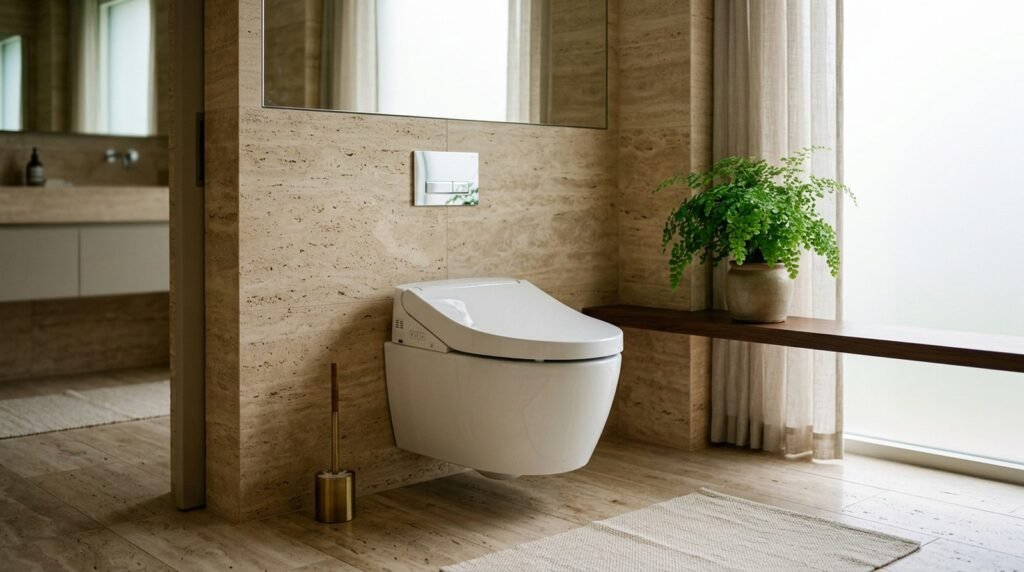
Smart Toilets in India 2026: Price, Features and a Buyer’s Guide for Luxury Homes
De Ceramica is a luxury tiles and sanitaryware showroom in Gurugram, an AD Pro-listed Hansgrohe Flagship Partner with 22+ years of experience helping homeowners and architects specify premium bathrooms across Delhi NCR. A smart toilet — sometimes called an intelligent toilet, washlet or shower toilet — is a one-piece or seat-based fixture that integrates a bidet wash, heated seat, automatic flush, deodoriser and remote control into a single unit, often with Wi-Fi or Bluetooth connectivity. In India, the category has moved from novelty to specification standard for high-end homes in the last three years, and 2026 is the year it crosses into mainstream luxury bathrooms in Gurgaon, Delhi and Mumbai.
This guide explains what smart toilets actually do, what they cost in India in 2026, the brands worth considering, and what to verify before you buy.
What Is a Smart Toilet and How Does It Work in an Indian Bathroom?
A smart toilet replaces the traditional ceramic WC and seat with a unified fixture controlled by sensors and a side-mounted or wall-mounted remote. The core functions are a warm-water bidet wash with adjustable nozzle position, a heated seat with multiple temperature settings, automatic seat opening and closing, automatic flushing, a warm-air dryer, a deodoriser, and a self-cleaning nozzle. Higher-end models add night lighting, programmable user profiles, water and energy savings tracking, and integration with home automation systems through Wi-Fi or Bluetooth.
The two formats most commonly specified in Indian homes are the integrated smart toilet, which is a single ceramic body with all electronics built in, and the smart toilet seat, which retrofits onto a compatible existing pan. For a new bathroom in a luxury home, the integrated unit is the cleaner specification. For a renovation where the WC outlet position cannot easily be changed, a smart seat from a brand like TOTO or Duravit is the practical answer.
How Big Is the Smart Toilet Market in India in 2026?
India’s smart toilet market generated USD 286.7 million in revenue in 2022 and is projected to reach USD 716.5 million by 2030 at a CAGR of 12.1%, according to Grand View Research. A more recent estimate from Ken Research places the 2024 market at USD 245 million, with Delhi NCR, Mumbai and Bengaluru as the dominant demand centres.
The growth is concentrated in residential luxury and hospitality. India is expected to cross 50 million smart homes by 2025 (Ken Research), and the smart toilet is now treated by leading developers and architects in Delhi NCR as a default for primary bathrooms in homes priced above approximately INR 5 crore. The two clusters where adoption is highest in the Delhi NCR market are Sushant Lok, Golf Course Road and DLF Phase 1 to 5 in Gurgaon, and Vasant Vihar, Defence Colony and Greater Kailash in South Delhi.
What Are the Best Smart Toilet Brands Available in India in 2026?
Five brands carry the bulk of premium specifications in India. Three are Japanese or German market leaders — TOTO, Duravit and Kohler. Two are domestic premium brands — Jaquar and Hindware. The choice between them is not just price; it is engineering tolerance, after-sales service, and design language.
| Brand | Origin | Entry-level price (INR) | Flagship price (INR) | Best for |
|---|---|---|---|---|
| TOTO Washlet | Japan | 20,000 (basic seat) | 3,50,000+ (Neorest) | The reference benchmark; widest range from retrofit seat to integrated flagship |
| Duravit SensoWash / ME by Starck | Germany | 1,20,000 | 4,00,000+ | Architect-led design, integration with Duravit ceramics, Philippe Starck design language |
| Kohler Numi / Veil | USA / global | 1,50,000 | 5,00,000+ | Smart home integration, app control, hospitality projects |
| Jaquar Opal Prime / Sensory | India | 40,000 | 2,50,000 | Wide service network, faster spares availability, value-luxury tier |
| Hindware Italian Collection | India | 35,000 | 1,80,000 | Entry into smart sanitaryware, accessible pricing |
Prices are indicative for product only and do not include installation, electrical work or plumbing modifications. Hindustan Times reports that a fully featured Japanese washlet with heated seat and remote starts at approximately INR 1.2 lakh in India, which aligns with the working specification ranges seen at the De Ceramica showroom in Sushant Lok Phase 1.
What Features Actually Matter in a Smart Toilet?
It is easy to be impressed by feature sheets that list 30 functions. In practice, a small set of features defines whether a smart toilet is genuinely usable.
- Adjustable spray pressure and nozzle position. A bidet wash that cannot be tuned will be uncomfortable for at least one member of the household.
- Heated seat with at least three temperature levels. Delhi NCR winters justify it; the comfort difference is significant.
- Self-cleaning, antibacterial nozzle. Without it, hygiene degrades faster than buyers expect.
- Tankless or low-tank operation. Cleaner aesthetics and better water efficiency, especially for wall-hung formats.
- Power-loss flush. A manual flush option that works during a power cut. Non-negotiable in India.
- Voltage and water-pressure tolerance. Indian voltage fluctuates; Indian water pressure varies. Flagship Japanese and German models include voltage stabilisers and pressure regulators. Cheaper imports often do not.
“The single most under-discussed feature in India is power-loss handling. A smart toilet that cannot flush during a 30-minute outage is not a luxury fixture, it is a liability. Every model on display at our Gurgaon showroom is verified for this,” says the De Ceramica specification team.
How Much Does a Smart Toilet Cost in India in 2026 — All In?
The product price is one component. The all-in cost in a Delhi NCR luxury bathroom typically breaks down as follows.
| Cost component | Entry premium (INR) | Mid premium (INR) | Flagship (INR) |
|---|---|---|---|
| Smart toilet unit | 40,000 – 90,000 | 1,20,000 – 2,50,000 | 3,00,000 – 6,00,000+ |
| Concealed cistern (if wall-hung) | 15,000 – 25,000 | 25,000 – 45,000 | 45,000 – 75,000 |
| Electrical point and isolation | 5,000 – 8,000 | 8,000 – 12,000 | 12,000 – 18,000 |
| Plumbing modification (if needed) | 10,000 – 20,000 | 15,000 – 30,000 | 20,000 – 40,000 |
| Installation and commissioning | 5,000 – 10,000 | 10,000 – 18,000 | 18,000 – 30,000 |
| All-in budget | 75,000 – 1,50,000 | 1,80,000 – 3,55,000 | 3,95,000 – 7,63,000+ |
For a balanced view of how a smart toilet fits within a complete bathroom budget, see our guide to how smart toilets fit into a luxury bathroom renovation budget.
What to Verify Before You Buy a Smart Toilet in India
Five technical questions separate a confident purchase from a regret.
- Water pressure at the inlet. Most premium smart toilets require 1.0 to 5.5 bar at the inlet. In older Delhi NCR housing without booster pumps, actual pressure can sit at 0.6 to 1.0 bar. A pressure pump in the bathroom riser is often required.
- Power supply. A dedicated 16A point with surge protection should sit within 1 metre of the WC and behind a panel. Coordinate this at the electrical layout stage, not after tiling.
- Outlet type and rough-in dimension. Floor-mounted units use a P-trap or S-trap; wall-hung units use a horizontal outlet at a specified height. Mismatched dimensions are the most frequent cause of last-minute changes on site.
- Service network. Imported units have longer service-call lead times than domestic ones. Verify the brand’s authorised service partner in Gurgaon, Delhi or Noida before committing.
- Spare-part availability. The remote, nozzle, deodoriser filter and seat sensor are wear parts. A reliable dealer keeps these in regional stock; a parallel importer often does not.
For broader fixture context, the complete guide to choosing sanitaryware for modern homes and the wider sanitaryware trends shaping Gurugram homes are useful pre-reads. Pairing a smart toilet with the right surrounding fixtures — basin, tap, shower — also depends on the broader bathroom architecture covered in our guide to integrating smart technology into a luxury bathroom design.
Where to See Smart Toilets in Person in Delhi NCR
A smart toilet is not a product to buy from a brochure. The seat warmth, wash pressure, lid action and noise level are physical experiences that no online listing communicates accurately. The De Ceramica luxury bathroom showroom in Gurugram displays integrated smart toilets and washlet seats from Duravit, TOTO and Jaquar, all live on water and power, with the bidet, dryer and remote functions available to test.
The showroom is at A-511, Sushant Lok Phase 1, Gurugram, near the IFFCO Chowk Metro station, and is open by appointment for design consultations with architects, interior designers and homeowners. The team includes specification specialists who can run pressure and electrical assessments for your project before you commit to a brand.
Plan a Smart Toilet Specification With De Ceramica
De Ceramica, an AD Pro-listed Hansgrohe Flagship Partner with 22+ years of experience, operates a 16,000 sq ft luxury sanitaryware and tiles showroom at A-511, Sushant Lok Phase 1, Gurugram. To book a smart toilet consultation or tour the displays in person, call +91 85880 09989 or visit the showroom.
Frequently Asked Questions
What is the price of a smart toilet in India in 2026?
Smart toilet prices in India in 2026 range from approximately INR 40,000 for an entry-level domestic model to INR 6,00,000 or more for a flagship Japanese or German integrated unit. A typical premium specification in a Delhi NCR luxury bathroom sits between INR 1,20,000 and INR 3,00,000 for the unit alone, with a further INR 30,000 to INR 60,000 for cistern, electrical, plumbing and installation.
Which is the best smart toilet brand in India?
The best smart toilet brand depends on the use case. TOTO leads on engineering depth and is the international reference for washlets. Duravit leads on integrated bathroom design language, particularly with the SensoWash and ME by Starck ranges. Kohler leads on smart home integration. Jaquar leads on accessible premium pricing and service network depth in India. Hindware is the value entry point.
Do smart toilets work in Indian water pressure conditions?
Most premium smart toilets specify a working inlet pressure of 1.0 to 5.5 bar. Many older Delhi NCR homes operate at 0.6 to 1.0 bar at the WC outlet, which is below the minimum. The fix is a small inline booster pump at the bathroom riser. Most established Indian dealers, including De Ceramica, will assess pressure on site before finalising the specification.
Can a smart toilet replace a regular toilet during renovation?
Yes, but a like-for-like swap is rarely as simple as it appears. A smart toilet requires a dedicated electrical point, a water inlet, often a different rough-in dimension and frequently a wall-mounted concealed cistern. For a clean replacement, plan the electrical and plumbing alterations during the renovation, not after tiling is complete.
Are smart toilets hygienic?
Yes, a quality smart toilet is more hygienic than a conventional WC. The bidet wash, self-cleaning antibacterial nozzle, automatic flush and deodoriser combine to reduce manual contact with the fixture. The hygiene depends entirely on the model — entry-level imports without self-cleaning nozzles do not deliver the same outcome as a TOTO Neorest or Duravit SensoWash.
Where can I see and compare smart toilets in person in Gurgaon?
De Ceramica, a luxury tiles and sanitaryware showroom in Gurugram, displays integrated smart toilets and washlet seats from Duravit, TOTO and Jaquar, all live on water and power. The showroom is at A-511, Sushant Lok Phase 1, Gurugram, near the IFFCO Chowk Metro station, and accepts appointments by phone on +91 85880 09989.